
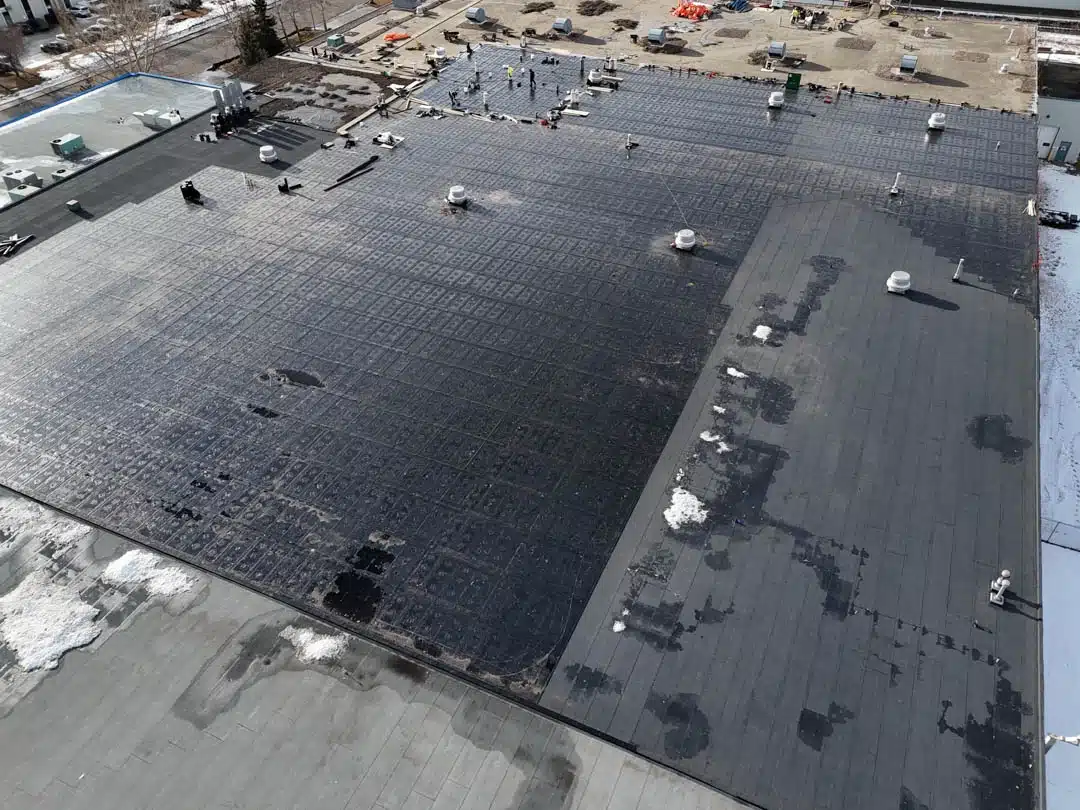
Not all flat roofs are created equal. Some can shrug off decades of storms, while others start leaking before your warranty runs out. The secret? It’s not just the material; it’s matching the right roof to the right building, in the right climate, with the right installer.
Choosing the right material for a flat roof isn’t as simple as picking whatever the last guy used.

I’ve seen top-of-the-line systems fail after five years, and cheaper ones last 25, all because the wrong material was picked for the wrong situation.
Let’s cut through the marketing noise and get to the truth: What are the real options for flat roof materials today, and which one’s actually best for your property?
Understanding Flat Roof Systems: Not All “Flat” Roofs Are the Same
Before we talk materials, it’s worth clearing up that flat roofs aren’t actually flat. They have a slight pitch (usually 1-10 degrees) for drainage. And not all systems are built the same way.
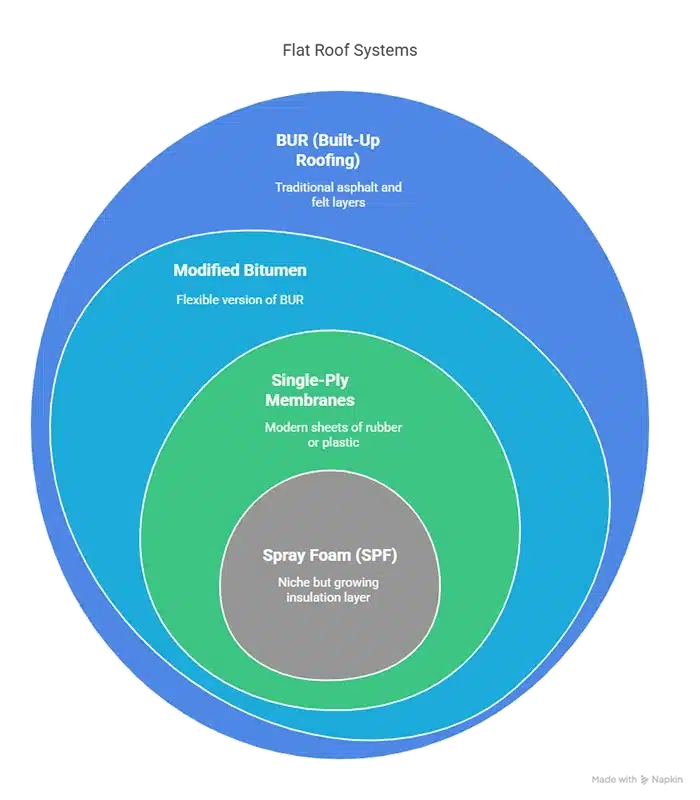
Most flat roofs you’ll come across fall into one of these system types:
- BUR (Built-Up Roofing): Layers of asphalt and felt, topped with gravel. Old-school but reliable.
- Modified Bitumen: A more modern, flexible version of BUR, usually installed in rolls.
- Single-Ply Membranes: Big sheets of rubber or plastic (like TPO, EPDM, or PVC) that are heat-welded or glued into place.
- Spray Foam (SPF): A sprayed insulation layer coated with waterproof material, more niche, but growing.
I’ve installed each of these systems hundreds of times, and I can tell you, your climate, building use, and budget will determine which one makes sense for your situation.
Wondering about costs for your specific project? Our Free Flat Roof Cost Calculator gives you instant estimates based on your roof size, material choice, and location. Get real numbers in under 2 minutes – no signup required, just honest pricing to help you plan your budget.
The Main Flat Roof Material Options (And What They’re Really Like)
Let me give you the unfiltered truth about each option. Not what the manufacturers’ brochures say.
BUR (Built-Up Roofing)
Think of BUR as the tank of flat roofs, heavy, tough, and built for the long haul. Multiple layers of bitumen (asphalt or coal tar) and felt, finished with gravel.
Pros: Tough as nails. I’ve repaired BUR roofs that were 35+ years old and still holding up. Excellent waterproofing when done right, and the gravel layer provides good UV and fire protection.
I remember inspecting a commercial property in Chicago after a brutal winter with -30°F temperatures. The neighbouring buildings with single-ply systems were dealing with cracks and splits, but the 22-year-old BUR roof was solid as the day it was installed.
Cons: Heavy, about 5-6 pounds per square foot. That’s 2-3 times heavier than single-ply. Not ideal for lightweight structures or if your building has structural concerns.

Best for: Old-school commercial buildings that can handle the weight. Restaurants and buildings in high-traffic areas benefit from its multi-layer protection.
Real-world durability: 20-30 years with proper installation and maintenance.
“Pro Tip: Warm roof vs. cold roof design isn’t just about insulation; it affects condensation, drainage, and roof life.”
👉 Warm or Cold Roof? Guide to Flat & Low-Slope Roofing Design
Modified Bitumen
BUR’s cooler, more flexible cousin. Usually torch-applied or self-adhered in rolls.
Pros: Handles building movement and temperature fluctuations better than BUR. Self-healing properties for minor punctures. Available in reflective options to reduce cooling costs.
Cons: Installation quality varies widely. I’ve seen mod-bit roofs fail at 7 years because the contractor rushed the seams. Fire risk during torch-down installation if not done by professionals.
Best for: Homes or small commercial properties needing a balance between old and new methods. Works well in areas with moderate temperature swings.
Real-world durability: 15-20 years with good installation.
EPDM (Rubber Roofing)
The “big black rubber roof” you’ve probably seen. Synthetic rubber membrane, typically black but can be white.
Pros: Simple installation means lower labour costs. Extremely flexible in cold weather, I’ve installed it at -20°F without issues. Resistant to UV damage and ozone.
Cons: Seams rely heavily on adhesives and can fail over time. Black EPDM absorbs heat like crazy (internal temps can increase 20-30°F on hot days). More prone to punctures than other options.
Best for: Budget-conscious owners in cooler climates. Northern states and Canada, where cooling costs aren’t a major concern.
Real-world durability: 15-20 years, with seams usually being the first failure point.
TPO (Thermoplastic Polyolefin)
Today’s commercial darling. A bright white membrane, heat-welded at the seams.
Pros: Reflects up to 87% of solar heat (can reduce cooling costs by 15-30% compared to dark roofs). Welded seams are stronger than adhesives. More environmentally friendly than PVC.
A client in Arizona switched from black EPDM to white TPO during a re-roof and called me six months later, amazed that his summer cooling bill had dropped by nearly a third. The building manager said the staff no longer complained about the second floor being too hot to work on sunny afternoons.
Cons: Quality varies drastically between manufacturers. I’ve seen some budget TPO turn brittle after just 8 years in sunny climates. Installation requires skill with a heat welder.
Best for: Modern commercial buildings and energy-conscious homeowners, especially in sunny regions like the southern US.
Real-world durability: 15-25 years, depending entirely on the manufacturer and installer quality.
PVC (Polyvinyl Chloride)
PVC is the luxury sports car of flat roof membranes, sleek, high-performance, but with a premium price tag. Durable, chemical-resistant, and built to last.
Pros: Stands up to ponding water better than any other single-ply. Highly resistant to grease, chemicals, and animal fats. Heat-welded seams create what’s essentially a single piece of material.
A client who owns a chain of fast-food restaurants switched all his locations to PVC after seeing how it handled the grease from kitchen exhausts. His maintenance costs dropped by 70% in the first three years alone, no more emergency repairs from deteriorated membrane around the vents.
Cons: The most expensive single-ply option. Contains chlorine, making it less eco-friendly to manufacture. Gets brittle in extreme cold if not properly formulated.
Best for: Restaurants, food processing facilities, and industrial buildings where chemical resistance matters. Also great for zero-slope roofs where water might pond.
Real-world durability: 20-30+ years when properly installed.
Spray Foam Roofing (SPF)
The oddball that’s quietly gaining ground. Spray-applied polyurethane foam with a UV coating.
Pros: Seamless (literally zero seams to fail). Provides insulation values of R-6 to R-7 per inch. I’ve seen buildings cut heating/cooling costs by 30%. Conforms to odd shapes and can build up low spots.
Cons: Extremely installation-dependent. A bad spray day ruins everything. Coatings must be reapplied every 5-10 years. Can’t be installed in wet or extremely cold conditions.
Best for: Buildings needing both roofing and insulation upgrades in moderate climates. Great for unusual roof shapes where traditional membranes would have too many seams.
Real-world durability: 20+ years with proper coating maintenance.
Best Flat Roof Material by Situation
There’s no “one best” — it depends on what you actually need. Here’s a cheat sheet:
| Situation | Best Material |
|---|---|
| Tight budget | EPDM |
| Hot sunny climate | TPO |
| Heavy foot traffic | Modified Bitumen or BUR |
| Industrial use (chemicals/fats) | PVC |
| Want insulation + waterproofing in one shot | Spray Foam |
| Need maximum lifespan | PVC or high-quality BUR |
| Extreme cold climates | Modified Bitumen or EPDM |
| DIY-friendly | Self-adhered Modified Bitumen |
Ballpark Cost Comparison (Installed)
I hate when articles don’t talk about cost. Here’s what you’re likely looking at in today’s market:
| Material | Estimated Installed Cost (USD) |
|---|---|
| BUR | $5.00 – $9.00 per sq. ft. |
| Modified Bitumen | $4.00 – $8.00 per sq. ft. |
| EPDM | $4.00 – $7.00 per sq. ft. |
| TPO | $5.00 – $8.00 per sq. ft. |
| PVC | $6.00 – $10.00+ per sq. ft. |
| SPF | $4.00 – $7.00 per sq. ft. |
Note: These prices reflect US market rates. UK and Canadian pricing will differ due to currency exchange rates, local material availability, and regional labour costs. Every country has its own pricing structure for roofing work, and even within countries, costs can vary significantly by region. Urban areas typically command higher prices than rural locations.
Remember, larger roofs usually mean lower per-square-foot costs. Complex roofs with lots of penetrations will be on the higher end of these ranges.
Comparing different roofing options? Our interactive cost calculator lets you compare TPO, EPDM, modified bitumen, and other materials side-by-side. See real cost differences for your specific roof size and get instant estimates for materials, labour, and total project costs.
Regional Considerations That Matter
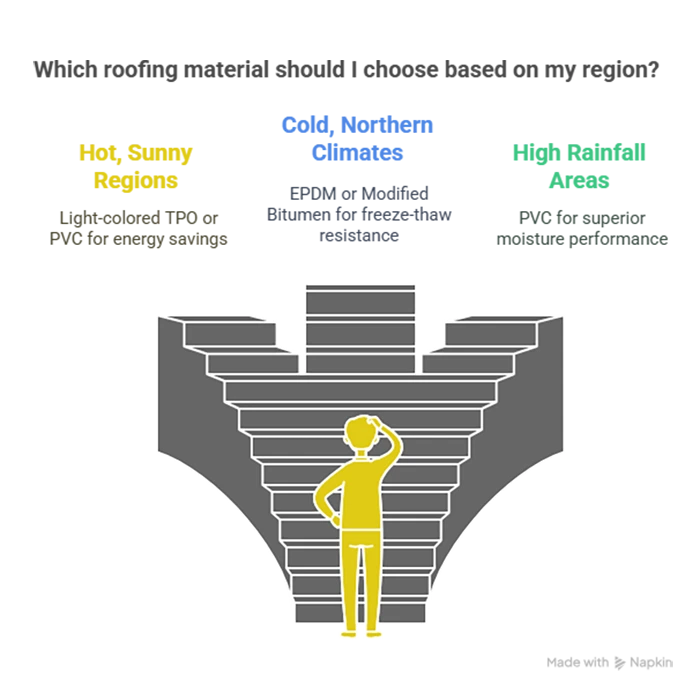
Your location should influence your material choice:
- Hot, sunny regions (Southern US, parts of Australia): Light-colored TPO or PVC is worth the extra cost; you’ll make it back in energy savings.
- Cold, northern climates (Canada, Northern US, UK): EPDM or Modified Bitumen handle freeze-thaw cycles better.
- High rainfall areas (Pacific Northwest, UK): PVC is worth considering for its superior performance with constant moisture.
- Hurricane zones: Fully-adhered systems rather than mechanically attached. The extra adhesive costs less than having your roof peel off in high winds. I once inspected a strip mall in Florida after a Category 3 hurricane; the mechanically attached sections had peeled back like a sardine can, while the fully adhered portions remained intact.
“Pro Tip: Think your roof just needs a patch? Be careful, patch jobs often fail if you miss the real issue. Our guide breaks down when flat roof repairs work, and when they don’t.”
👉 Flat Roof Leak Repair Guide
Emerging Trends in Flat Roofing

The industry isn’t standing still. Here are some innovations worth considering:
- Cool Roof Coatings: Aftermarket white coatings can be applied to existing dark roofs to improve energy efficiency without a full replacement.
- Green Roof Systems: Living vegetation installed over waterproof membranes (usually PVC or TPO) provides incredible insulation and stormwater management.
- Solar-Ready Membranes: Some manufacturers now offer membranes specifically designed for solar panel installation, with reinforced attachment points.
- Self-Healing Modified Bitumen: Newer polymer-modified products have improved self-healing properties for minor punctures.
Myth-Busting: Flat Roof Facts vs. Fiction
| Myth | Fact |
|---|---|
| All flat roofs eventually leak | A properly installed flat roof can be as watertight as any pitched roof |
| Flat roofs don’t last as long as shingles | Top-quality flat roofs often outlast standard shingles by 5-10 years |
| You can’t walk on flat roofs | Most commercial flat roofs are designed for regular maintenance traffic |
| Ponding water is always a problem | Some materials (like PVC) can handle permanent ponding without issues |
| DIY installation saves money | The cost of mistakes almost always exceeds professional installation costs |
🏠 Quick Decision Guide: Finding Your Best Roofing Match
💰 What’s your budget?
| Tight Budget → EPDM | Medium Budget → Modified Bitumen / TPO | Premium Budget → PVC |
⏰ How long do you need it to last?
| 10-15 years → EPDM | 15-20 years → TPO | 20+ years → PVC or BUR |
🌡️ What’s your climate?
| Hot & Sunny → White TPO / PVC | Cold Climate → EPDM / Modified Bitumen | Wet Climate → PVC |
🏢 What’s your building use?
| Restaurant / Industrial → PVC | Office / Retail → TPO | Residential → Modified Bitumen |
🌡️ Need extra insulation?
| Yes → Consider SPF | No → Any other system |
📋 Material Quick Reference:
Tip: On mobile, scroll horizontally to see all options in each row
Final Thoughts: Choose the Roof, Not the Hype
Flat roofs aren’t forgiving when mistakes happen, and picking the wrong material is one mistake that’ll cost you thousands down the line.
Best advice? Think beyond the initial price tag. Look at your climate, your building’s structure, how much traffic you expect, and how long you want it to last.
I always tell my clients to get at least 3 proposals and independent inspections if possible. The US, UK, and Canada all have their own regulations and code requirements that must be followed. What works in Florida may not be code-compliant in Ontario or Manchester.
And if you’re unsure? That’s exactly why I built the Flat Roof Advisor. Real advice. No sales pitch. Get a second opinion before you sign anything.
Not sure which roofing system fits your budget? Our cost calculator breaks down pricing for all major flat roof materials. Compare TPO, EPDM, modified bitumen, and PVC costs instantly to find the best value for your specific situation and climate.
FAQs About Flat Roof Materials
What is the longest-lasting flat roof material?
PVC and high-quality BUR systems can last 25–30 years or more when properly maintained.

What is the cheapest flat roof material?
EPDM (rubber roofing) tends to be the most affordable upfront.
Which flat roof material is most energy-efficient?
TPO and PVC both reflect sunlight very well, helping reduce cooling costs in hot climates.
Can flat roof materials be installed over an existing roof?
Sometimes, yes — particularly with systems like TPO or Modified Bitumen. But it depends on the condition of the existing roof and local building codes.
Is spray foam roofing a good idea?
It can be — if installed and maintained correctly. SPF offers great insulation but needs regular recoating to stay effective.
How do I know if my building can support a heavier roof system?
Have a structural engineer evaluate your building before switching from a lightweight system (like EPDM) to a heavy one (like BUR).
Want more insights from the field? Don’t miss these next reads:
- Learn about installation techniques: Flat Roof Installation: A Step-by-Step Guide
- Compare Materials: TPO vs. EPDM Roofing – Which Is Better?
- Estimate replacement costs: Cracking the Code: Flat Roof Replacement Costs in 2025
 About Peter Coscolin


